
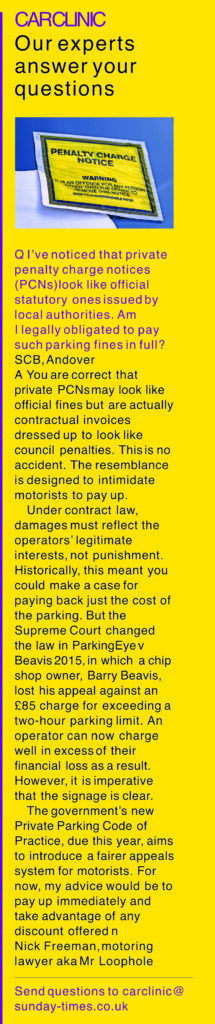
 In this Car Clinic piece I wanted to tackle one of the most common and frustrating questions motorists raise with me: whether private parking charge notices really have to be paid.
Many drivers are understandably confused because these private PCNs are deliberately designed to look like official council fines. That similarity is no accident. It is intended to intimidate people into paying quickly, often without stopping to question whether the charge is lawful or fair.
In the article, I explain that these notices are not criminal or statutory penalties. They are, in legal terms, contractual invoices. When you park on private land, you are entering into a contract, and the parking company is claiming that you have breached its terms.
Historically, this gave motorists more room to argue. Under traditional contract law, a company could usually only recover its genuine financial loss. In many cases, that was little more than the cost of the parking itself.
However, that position changed following the Supreme Court decision in ParkingEye v Beavis in 2015. That case confirmed that parking operators can lawfully charge more than their actual loss, provided the charge protects a legitimate business interest and is not simply a punishment. This ruling reshaped the entire private parking landscape.
That said, I make it clear that operators do not have a free hand. Everything still depends on proper signage and transparency. If the terms are unclear, misleading, or badly displayed, the charge may still be open to challenge.
I also highlight the government’s proposed Private Parking Code of Practice, which is intended to improve standards and create a fairer appeals system. While progress has been slow, it reflects growing concern about how parts of the industry operate.
My concluding advice is deliberately practical. Where the signage is clear and liability is likely, it is often sensible to pay promptly and take advantage of any discount. Prolonged disputes can be stressful, time-consuming, and financially risky.
Overall, this piece is about cutting through the confusion. It explains where motorists stand legally, why private parking charges exist, and how to deal with them sensibly, rather than reacting out of fear or frustration.

